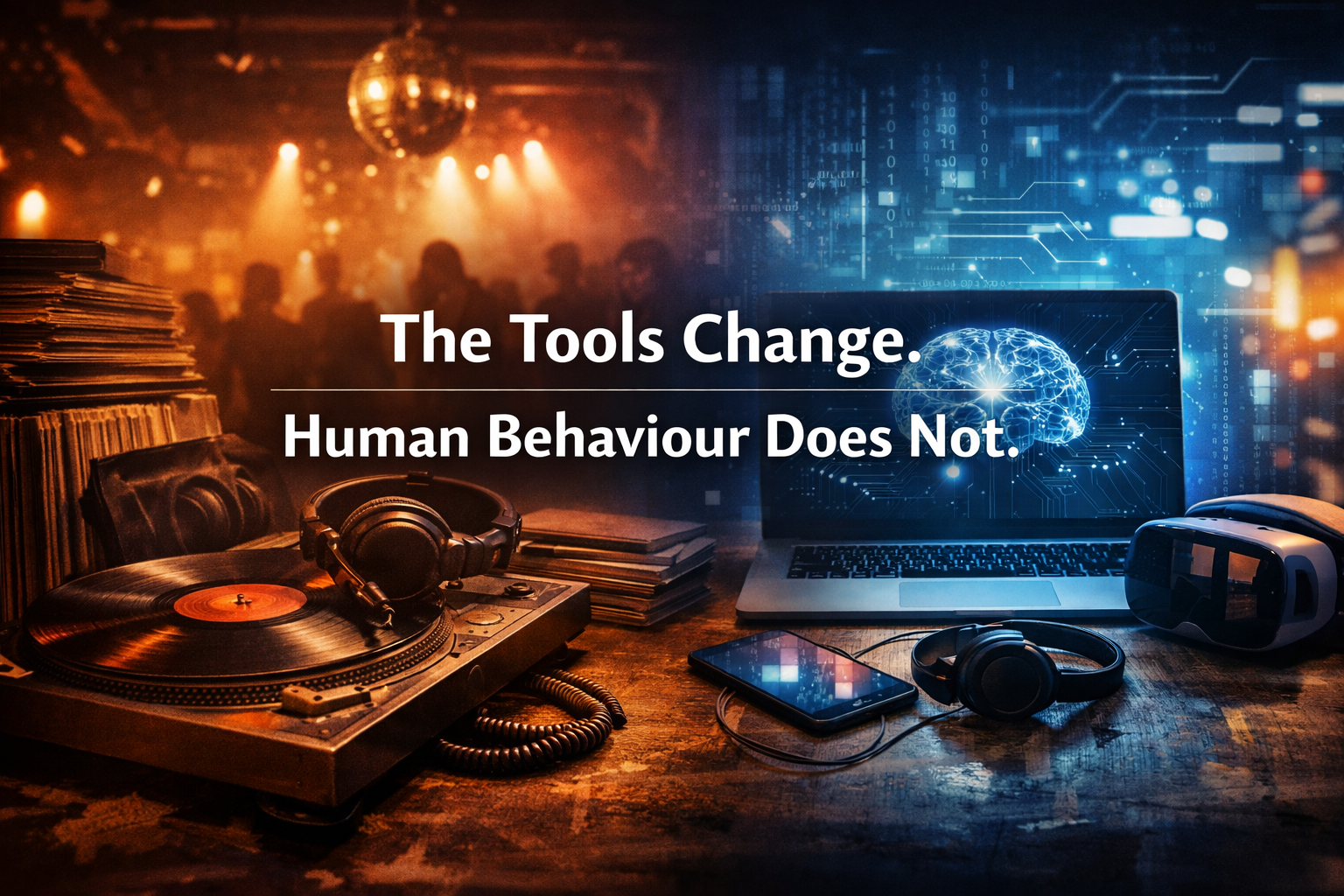
The Tools Change. Human Behaviour Does Not
Music scenes used to be discovered slowly.
A sound would emerge in one place, move through clubs and record shops, and gradually travel through DJs, radio and word of mouth. It could take years before something local became globally recognised.
Today discovery happens much faster.
A clip from a set pops up online. Someone hears the sound for the first time in London, someone else in São Paulo, someone else in Tokyo. Within days thousands of people miles away are loving the same track.
But that doesn’t mean the culture appeared overnight.
Afro House is a good example. Artists like Black Coffee have been playing and developing that sound for years. Technology didn’t create the culture. It simply made it easier for people far away to discover it.
The tools change.
Human behaviour does not.
When Trends Look Like Subcultures
That speed has changed something else too.
When culture spreads this quickly it can sometimes create trends that look like subcultures.
The aesthetic appears first.
The symbols appear first.
The music, the clothes, the language.
But what often takes longer is the depth behind it.
Real subcultures usually form through repetition. Through people showing up again and again in the same places.
Clubs.
Record shops.
Skate parks.
Running clubs.
That repetition creates something algorithms can’t manufacture.
Ritual.
Ritual simply means people showing up again and again. The same places, the same communities, the same shared signals over time.
Over time those repeated moments build depth.
Algorithms can spread signals quickly.
Ritual is what makes them last.
Where Ritual Begins
When I was younger I spent Saturdays in the record shops in Liverpool.
Where the record shops were was in a shopping precinct called The Palace. Aside from the record shops there were other alternative shops and independent sellers.
Over time the same people would show up each week.
You’d recognise faces.
Conversations would start.
Music would be shared.
Slowly you became part of something.
Looking back, it wasn’t just about buying records.
It was a ritual.
And that ritual created depth.
Technology Accelerates Discovery
Technology has changed where those rituals begin.
Sometimes it starts with a clip online. Someone hears a track they’ve never heard before. Thousands of people miles away are loving the same moment.
Sometimes that discovery leads people deeper. They follow the artists, attend events and find communities around the music.
Other times it stays on the surface and disappears as quickly as it arrived.
That’s the difference between visibility and depth.
The AI Acceleration
AI will accelerate this even further.
Music, images, brands and entire aesthetics can now be generated almost instantly.
Signals that once took years to develop can now appear overnight.
But that raises an interesting question.
If signals become infinitely producible…
What actually proves something is real?
AI will flood culture with signal.
New trends, sounds and ideas will appear faster than ever before. Some will spread across the world overnight.
But the real test won’t change.
The things that last will still be built on ritual, authentic connection and community.
People showing up.
People caring.
People returning.
Technology may accelerate discovery.
But culture is still built by humans.
The tools change.
Human behaviour does not.